

Creatine supplements rank among the most popular supplements in sports nutrition, yet many people remain confused about what actually happens inside their body when they take creatine. This guide breaks down the science, walks through practical dosing strategies, and addresses the safety questions that matter most.
Quick Answer: How Creatine Works in Your Body
Here’s the straightforward explanation: creatine is a naturally occurring compound stored in your muscles primarily as creatine phosphate (also called phosphocreatine). When you need quick energy—like during a heavy squat or sprint—your body burns through adenosine triphosphate, the main energy molecule powering muscle cells. The problem? You only have a few seconds’ worth stored.
This is where creatine helps regenerate ATP. Phosphocreatine donates its phosphate group to rebuild ATP almost instantly, letting you maintain power output for several extra seconds. Think of creatine as a fast-charging backup battery for your muscles—it kicks in precisely when your primary energy runs low.
Creatine supplementation increases your phosphocreatine stores by roughly 20-40%, translating to more reps, better sprint times, and greater total training volume over time. Smaller stores in brain tissue may also support cognitive function during demanding mental tasks.
What Is Creatine, Really?
Creatine is a natural compound your body synthesizes from three amino acids: arginine, glycine, and methionine. Amino acids are the building blocks of proteins, and creatine is closely related to these foundational building blocks, playing a key role in cellular energy.
Your liver, kidneys, and pancreas produce approximately 1-2 grams of creatine daily. An omnivorous typical diet adds another 1-2 grams from protein rich foods like red meat, poultry, and fish. Cow's milk is also a natural source of creatine, but increasing milk intake does not necessarily provide additional athletic benefits compared to creatine supplementation. About 95% of your body’s creatine sits in skeletal muscle tissue, with roughly 5% distributed to the brain and other organs.
A typical 70 kg adult carries 120-160 grams of total creatine. Vegetarians and vegans often have 20-50% lower baseline creatine levels since plant foods contain virtually none—making them particularly responsive to supplementation.
How Creatine Helps Produce Energy (The ATP-PCr System)
Your muscles rely on different energy systems depending on activity duration and intensity. For high intensity exercise lasting 5-30 seconds, the ATP-phosphocreatine system dominates.
Here’s the process:
-
ATP serves as your cells’ energy currency
-
Muscles store only 2-3 seconds of ATP at maximal effort
-
When ATP is used, it loses a phosphate and becomes ADP
-
Phosphocreatine rapidly donates its phosphate to ADP, regenerating ATP
-
This extends peak muscle performance by 5-15 additional seconds
This system powers activities like:
-
Heavy weight sets (1-10 reps)
-
100-meter sprints
-
Vertical jumps
-
Quick directional changes
For endurance activities exceeding two minutes, creatine offers minimal benefit since slower, oxygen-dependent pathways take over.

What Happens in Your Muscles When You Take Creatine?
When you begin taking creatine supplements, your muscle cells gradually reach saturation over days to weeks. Several changes follow:
Increased phosphocreatine stores: More available energy substrate means more total training volume—extra reps, heavier weights, better muscle performance across sessions.
Cell volumization: Creatine pulls water into muscle cells, increasing intracellular hydration. This creates a fuller appearance and may trigger anabolic signaling pathways. Early research and recent studies suggest this cellular swelling supports protein synthesis.
Initial weight gain: Expect 1-3 pounds (about half to one kilogram) of water weight in the first 1-2 weeks. This is intracellular water, not fat gain.
Over 8-12 weeks of consistent resistance training, studies suggest creatine users gain approximately 1-2 kg more lean mass compared to placebo groups. If you stop supplementation, creatine levels return to baseline within 4-6 weeks.
Types of Creatine: Why Creatine HCl Is the Gold Standard for Gummies
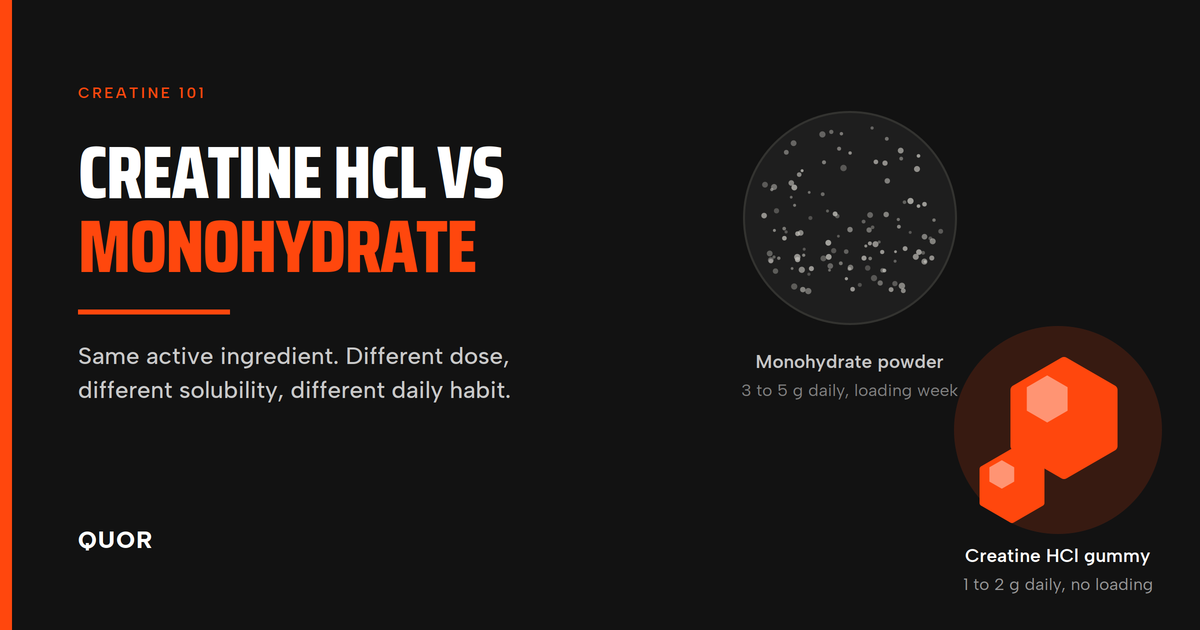
Creatine comes in several forms. They differ less in whether they work and more in how they're delivered — and how well they fit your routine.
| Form | Solubility | Research base | Best suited to |
|---|---|---|---|
| Creatine HCl | Highest — dissolves readily in minimal liquid | Smaller; delivers the same active creatine molecule | Gummies, no-shaker routines, sensitive stomachs |
| Creatine monohydrate | Low; needs a full glass of water, can leave grit | Largest — hundreds of trials | Anyone happy mixing a powder daily |
| Creatine ethyl ester | Moderate | Limited; may convert to inactive creatinine | Little reason to choose over the above |
| Buffered creatine | Moderate | Limited; no demonstrated advantage | Little reason to choose over the above |
How to Take Creatine: Dosing, Loading, and Timing
Creatine works by saturation, so daily consistency matters more than precise timing.
Loading phase option:
-
20 grams of creatine daily (4 × 5-gram doses) for 5-7 days
-
Then transition to a maintenance dose of 3-5 grams creatine daily
No-load option:
-
Simply take 3-5 grams daily from the start
-
Muscles reach saturation in 3-4 weeks
Both approaches yield identical long-term results. The maintenance phase keeps stores elevated indefinitely with consistent use.
What to Take (and Not Take) With Creatine
Pairing creatine with carbohydrates and adequate protein may modestly enhance uptake and support muscle growth through insulin signaling. However, it’s not strictly required.
Practical considerations:
-
Caffeine interactions appear minimal in most modern studies
-
Avoid pre-workouts with hidden “proprietary blends”
-
Stay well-hydrated—creatine increases total body water
-
A well balanced diet with sufficient protein intake maximizes benefits
Benefits of Creatine for Performance, Physique, and Brain
The effects of creatine are well-documented, with research highlighting its safety profile, benefits for athletic performance, muscle recovery, and its role in preventing age-related muscle loss. The int soc sports nutrition position stand and hundreds of controlled trials support creatine’s efficacy. Here’s what the scientific evidence shows:
Athletic performance: 8-14% improvements in muscle strength, 5-15% better power output in high intensity workouts and high intensity activities.
Physique: Enhanced muscle mass and greater lean body mass gains, especially when paired with strength training and structured workout routines.
Older adults: Creatine may support bone health, counter sarcopenia, and preserve functional independence—creatine may help those 50+ maintain muscle tissue.
Brain health: Studies suggest improvements in brain function during sleep deprivation or in vegetarian populations with lower baseline levels.

Who Might Benefit Most From Creatine?
-
Professional athletes and recreational lifters seeking more energy for intense exercise
-
Vegetarians/vegans (typically show 30-50% greater responses)
-
Older adults engaged in physical activity and resistance training
-
Anyone pursuing enhancing muscle mass through progressive overload
Note that 20-30% of users are “non-responders,” often those with high meat intake whose stores are already near saturation. Track your body weight and workout routines over 4-8 weeks to judge your personal response.
Side Effects, Safety, and Who Should Be Cautious
Creatine is a relatively safe supplement backed by decades of research. Long-term studies (3-5 years) show no adverse effects on kidney function or liver health in healthy adults at typical doses.
Common mild effects:
-
Transient water weight gain (not fat gain)
-
Occasional GI discomfort if large doses taken at once
-
“Fuller” muscle appearance
To minimize issues:
-
Split doses throughout the day
-
Take with food
-
Drink adequate fluids
Who should consult a healthcare provider:
-
Anyone with kidney disease or compromised kidney function
-
Individuals with significant liver conditions
-
Those with heart failure or complex medical histories
-
Pregnant or breastfeeding individuals
-
Adolescents (consult a pediatrician)
Common Myths About Creatine
-
“It’s a steroid”: False. Creatine doesn’t alter testosterone or sex hormones.
-
“It causes dehydration and cramping”: Research in athletes doesn’t support this; some studies show neutral or lower cramping rates.
-
“It causes hair loss”: Limited data on DHT changes are mixed and inconclusive.
-
“You lose everything when you stop”: Water weight may drop, but muscle tissue remains if training continues.
Creatine use is not a magic shortcut—results depend on consistent training, balanced diet, sleep, and recovery.
How Fast Does Creatine Work, and What Happens If You Stop?
With loading, many people notice performance differences within 5-7 days. Without loading, expect changes over 2-4 weeks. Visible physique changes—regardless of creatine—require several weeks of hard training.
After stopping:
-
Stores decline over 4-6 weeks to baseline
-
Scale weight may drop slightly (water)
-
Minor reductions in top-end strength or sprint capacity
-
No “withdrawal”—your body continues producing creatine naturally
View creatine as a long-term tool rather than something requiring frequent cycling.
Choosing a Quality Creatine Supplement
Since dietary supplements aren’t regulated as strictly as prescription drugs, quality varies widely. Here’s how much creatine matters—and what to look for:
Selection criteria:
-
Plain creatine monohydrate with minimal additives
-
Third-party lab testing results (purity, heavy metals, microbial safety)
-
cGMP-compliant manufacturing facilities
-
Transparent labeling showing exact grams per serving
Powder forms offer better value; capsules provide convenience for travel.
Creatine works best alongside build muscle fundamentals: progressive resistance training, adequate protein, quality sleep, and consistent physical activity. Whether you’re chasing athletic benefits, supporting sports health goals, or exploring weight loss and body recomposition, creatine remains one of the most evidence-backed tools available.
For those integrating creatine into a broader wellness routine—especially alongside other lab-tested supplements—trusted retailers like QUOR at quor.store offer transparency and quality you can verify.


Leave a comment
This site is protected by hCaptcha and the hCaptcha Privacy Policy and Terms of Service apply.