

Quick answer: HCl or monohydrate?
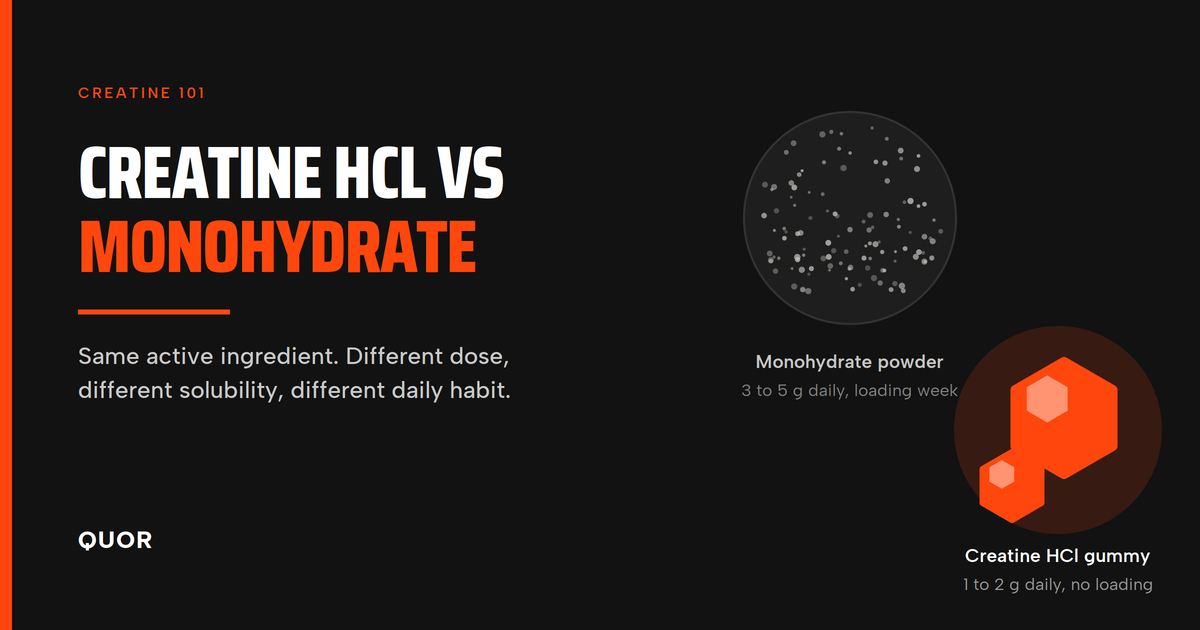
TL;DR: Both forms raise the creatine stored in your muscles and support strength and power. Monohydrate has the largest research base and the lowest cost. Creatine HCl is far more soluble and better absorbed, so it works at a smaller dose with no loading phase, which is a big part of why people who found monohydrate hard to stick with switch to HCl.
The two forms differ on four things that actually matter when you're choosing between them:
- Research backing: monohydrate has decades of clinical study behind it. HCl's research base is smaller and still growing.
- Solubility: HCl dissolves in water far more readily than monohydrate, which is the main reason it's positioned as easier to absorb.
- Digestion: some people report bloating or cramping with monohydrate, especially during loading, though the largest controlled trials haven't found a significant difference in gastrointestinal (GI) side effects between monohydrate and placebo. HCl's smaller dose and lack of a loading phase mean less volume to process at once, which is a common reason switchers say it sits easier.
- Dosing: monohydrate calls for 3 to 5 grams a day, and more during loading. HCl typically needs just 1 to 2 grams, once a day, with no loading phase.
QUOR builds every gummy on creatine HCl for exactly these reasons. Here's the full breakdown of how the two forms compare, and how to figure out which one fits you.
In this article
- What is creatine and why does the form matter?
- What is creatine monohydrate?
- What is creatine HCl?
- Creatine HCl vs monohydrate: side-by-side
- Does creatine HCl absorb better than monohydrate?
- Which one causes less bloating?
- How to dose creatine HCl (no loading needed)
- Which should you choose?
- The bottom line
- Frequently Asked Questions
What is creatine and why does the form matter?
Creatine is a compound your muscles and brain use to regenerate ATP, their fast-acting energy currency. Supplementing raises your creatine stores, which improves strength, power, and recovery. The "form" refers to what the creatine molecule is bound to, and that binding changes how well it dissolves and absorbs.
Creatine is a naturally occurring compound your body makes from three amino acids, arginine, glycine, and methionine, and stores mostly in your muscle tissue. Most creatine supplements are designed to boost those natural stores beyond what diet alone provides. Creatine increases the muscle's phosphocreatine reserves, which speeds up ATP (adenosine triphosphate) regeneration during short, intense exercise. That's the mechanism behind its role in energy production, and it's why creatine supplementation has such a strong reputation for supporting athletic performance.
Every legitimate form of creatine, whether it's monohydrate, HCl, or something else, delivers the same active ingredient: creatine. What changes from one form to the next is the compound it's attached to, and that compound affects solubility, digestion, and how much you need to take to get an effective dose. It doesn't change what creatine does once it's in your system.
That distinction matters because most of the debate around creatine forms isn't really about effectiveness. It's about how easy a given form is to take consistently, since consistency is what actually drives results over months of use. The two forms you'll run into most often are creatine monohydrate and creatine HCl.
Creatine is most useful for resistance training and other activities built around short bursts of power, like sprinting or heavy lifting, rather than steady-state cardio. That's why it shows up so often in strength and physique-focused supplement stacks, and why the comparison between forms tends to matter most to people who train that way.
For the fuller mechanics of how creatine works before comparing the two, QUOR's Creatine 101 hub is a good place to start.
What is creatine monohydrate?
Creatine monohydrate is creatine bound to one water molecule. It's the original, most-studied form, backed by decades of research showing gains in strength and muscle. It's affordable and effective but poorly soluble and often needs a loading phase, which some users find causes water retention or bloating.
Monohydrate earned its reputation honestly. It's the form used in the vast majority of creatine research, and it's widely considered the benchmark every other form gets measured against. It's also inexpensive relative to other forms, and a typical batch runs close to 90% creatine by mass. High-purity monohydrate can reach 99.9% purity, per FDA GRAS documentation for pharmaceutical-grade creatine monohydrate. If you only care about cost per gram and proven results, monohydrate is hard to beat.
It helps to understand how creatine monohydrate works: once absorbed, it converts to phosphocreatine and stores in muscle tissue, ready to regenerate ATP on demand. Even as newer forms gain ground, creatine monohydrate remains the most extensively researched option on the market, which is why it's still the default recommendation in most clinical guidelines.
The friction shows up in how you actually take it. Creatine monohydrate dissolves slowly in water and tends to leave a gritty residue at the bottom of the glass, which is why so many people describe it as chalky. Most protocols start with creatine loading: about 20 grams a day split into smaller doses for 5 to 7 days, before dropping to a 3 to 5 gram daily maintenance dose. The International Society of Sports Nutrition's position stand on creatine is the source most of this protocol comes from. It found that loading this way raises muscle creatine stores by 20 to 40 percent within the week, which is what lets people skip straight to a maintenance dose instead of building up gradually.
That loading phase, combined with the larger overall dose, is the reason some people report bloating, cramping, or general stomach discomfort with monohydrate. However, a 2026 dose-response analysis of 684 randomized controlled trials and more than 12,800 participants found no significant increase in gastrointestinal or other side effects for monohydrate compared to placebo, even at higher doses. This means not everyone tolerates monohydrate the same way; it's a form that asks more of your daily routine, with individual tolerance varying. The water retention some people notice with monohydrate is a temporary weight gain from water drawn into tissue, not fat gain, and it typically levels off once the loading phase ends.
What is creatine HCl?
Creatine hydrochloride, usually shortened to creatine HCl, is creatine bound to hydrochloric acid, which sharply increases its water solubility. That higher solubility supports better absorption, so an effective dose is smaller, around 1 to 2 grams, with no loading phase required and minimal bloating or water retention. Attaching creatine to hydrochloric acid is one of several approaches formulators use to improve solubility over standard monohydrate, and it's currently the most established of those alternatives.
The chemistry is straightforward. Attaching creatine to hydrochloric acid instead of a water molecule changes how readily it dissolves. Solubility studies and manufacturer testing commonly cite creatine HCl as dozens of times more soluble in water than monohydrate, often referenced around a 40-fold difference. That's a meaningful gap, and it's the mechanical reason HCl is formulated at a lower dose: less of it is needed to get into solution and, from there, into your system.
In practice, that means no gritty mixing, no 20-gram loading week, and a dose small enough to fit into a gummy instead of a scoop. QUOR builds its ENHANCE, POWER, and RECOVER gummies around creatine HCl specifically because of this solubility profile. Each formula is dosed for how the form actually behaves, not simply scaled down from a monohydrate serving.
Creatine HCl vs monohydrate: side-by-side
Both forms increase muscle creatine and support performance. Monohydrate wins on research volume and price. HCl wins on solubility and dose size, and skips the loading phase that some people find hard on their stomach. If you dislike mixing chalky powder or have found loading uncomfortable in the past, HCl is the more practical everyday choice.
Whether you're weighing creatine monohydrate vs HCl for the first time or deciding whether to switch, the table below breaks down where each form actually differs.
| Factor | Creatine Monohydrate | Creatine HCl (QUOR) |
|---|---|---|
| Solubility | Low, dissolves slowly | High |
| Absorption | Effective, needs a larger dose | More efficient at a smaller dose |
| Typical daily dose | 3 to 5 g | 1 to 2 g |
| Loading phase | Often 20 g/day for 5 to 7 days | None |
| Bloating, cramping, water retention | Some users report this, especially during loading | Reported less often; smaller dose, no loading phase |
| Format | Powder or capsules, requires mixing | Gummy, no mixing |
| Research base | Extensive | Growing |
| Cost per serving | Lower | Higher |
For lifters who want the deepest evidence base and the lowest price, monohydrate still makes sense. For anyone who wants the same underlying ingredient without the mixing, the loading week, or the digestive issues, HCl in a gummy format solves the adherence problem monohydrate creates. Neither column in the table above is padded to make a point. Monohydrate's deep research base and lower cost are a proven advantage, and those aren't small ones. HCl genuinely wins on the day-to-day experience of taking it, which is the part that determines whether you're still doing it in six months.
Creatine HCl vs monohydrate for muscle growth
For pure muscle growth, the two forms are on more even footing. Once your muscle creatine stores are saturated, whether you got there through monohydrate's loading phase or HCl's smaller daily dose, the strength and hypertrophy benefit comes from having enough creatine on board, not from which form got it there. Monohydrate has the deeper track record specifically for muscle-growth outcomes, since it's the form used in almost all the long-term training studies.
A 2017 meta-analysis of 22 trials and 721 older adults found monohydrate users gained an average of 1.37 kg more lean tissue mass (also called lean body mass) than placebo during resistance training, the kind of outcome data HCl doesn't yet have at the same scale. That's not a reason to assume HCl builds less muscle mass, just that fewer controlled trials have measured it directly. In practice, the form that grows more muscle is usually the one you actually keep taking. Either way, strength gains and body composition changes, including more lean mass over time, come down to consistent training and adequate creatine stores rather than the specific form you take.
Does creatine HCl absorb better than monohydrate?
Creatine HCl is markedly more water-soluble than monohydrate, which supports more efficient absorption and a smaller effective dose. This is why HCl typically doesn't require a loading phase. Monohydrate is still well absorbed; it simply needs a larger dose to saturate muscle stores.
It's worth being precise about what "better absorption" means here. Solubility and absorption are related but not identical: a compound that dissolves more easily in water generally has an easier time crossing into solution and being taken up by the gut, which is the mechanism behind HCl's smaller effective dose. That's different from claiming HCl delivers more creatine to your muscles per gram than monohydrate does. The International Society of Sports Nutrition's position stand on creatine notes that claims of superior muscle uptake for alternative creatine forms remain unfounded in controlled research. Monohydrate isn't outperformed on that front; it's simply saturating your muscle stores through a larger, less soluble dose instead of a smaller, more soluble one.
So the honest framing is this: HCl's real advantage isn't that it works better than monohydrate once it's in your system. It's that it's easier to get into your system in the first place, without the mixing, the loading week, or the digestive friction that keep some people from taking monohydrate consistently.

Which one causes less bloating?
Individual experience varies, though some people who feel bloated during monohydrate's loading phase find creatine HCl's smaller, single daily dose easier to tolerate. This is because there's less volume and no loading period to get through.
Anecdotally, bloating and cramping are the two complaints that come up most often with monohydrate, and people tend to link them to how it's dosed. The loading phase is where creatine monohydrate most often leads people to report digestive discomfort, an upset stomach, or a heavier feeling around the midsection, since it pulls extra water into muscle cells in a short window, especially if they aren't drinking enough water alongside it.
Because HCl dissolves so much more readily and is dosed at a fraction of the amount, that friction mostly disappears. Most people taking 1 to 2 grams of creatine HCl a day report little to no bloating, no loading-related cramping, and nothing to mix or measure out. That's an experiential difference, not a medical claim, but it's the single biggest reason people who've tried and stopped monohydrate end up trying HCl next.
If you do stick with monohydrate, staying well hydrated and spreading the loading dose across several smaller servings a day, rather than taking it all at once, tends to ease the discomfort for people who are sensitive to it.
How to dose creatine HCl (no loading needed)
A typical creatine HCl dose is 1 to 2 grams once daily, taken consistently, with no loading phase required. Because HCl is more soluble, you can skip loading altogether and start at a normal daily dose from day one. Consistency over time matters more than timing.
There's no loading week to plan around and no maintenance phase to switch into later. You take the same dose every day from the start, and your muscle creatine stores build gradually over the first few weeks, similar to where a monohydrate user lands after loading, just without the up-front spike in dose. Timing isn't strict. Taking it with a meal is common practice and can help with tolerance, but the main variable that matters is whether you take it at all, every day.
QUOR's gummies are dosed with this in mind. A 5-gummy serving of POWER delivers 3,000 mg (3 g) of creatine HCl, while ENHANCE and RECOVER each deliver 2,000 mg (2 g) per serving, with their own nootropic or recovery-focused ingredients layered on top. Take one serving a day, on a schedule you can actually stick to. Skipping the loading phase only helps if the daily habit itself sticks.

Which should you choose?
Choose monohydrate if you want the lowest cost and the deepest research base and don't mind mixing powder or a loading phase. Choose creatine HCl if you want a smaller dose, no loading, minimal bloating, and an easier daily habit. For convenience and adherence, HCl in gummy form is the simplest option.
If creatine is a new supplement for you, HCl's simpler, no-loading schedule makes it an easier place to start than working through a monohydrate loading week.
Neither form is wrong. Monohydrate is the safer default if you're optimizing purely for evidence and price, and there's no reason to talk anyone out of it. But if your priority is actually taking creatine every day, for months, without a loading week, a shaker bottle, or a bloated stomach getting in the way, creatine HCl is built for that.
This is also where a lot of people land on HCl after already trying monohydrate first. If the powder gave you cramping, bloating, or a routine you kept skipping because mixing it felt like a chore, switching forms addresses the actual problem instead of asking you to push through it.
QUOR's three formulas make that choice specific instead of generic:
- ENHANCE, for focus and everyday mental performance
- POWER, for training performance and strength
- RECOVER, for muscle recovery and rest

Across all three formulas, the shared goal is supporting muscle performance and recovery without adding a second supplement routine to manage. Each one is built on creatine HCl, dosed for the form, and delivered as a gummy instead of a powder. That's the practical answer for anyone who's decided the daily habit matters more than the loading protocol. The focus and cognitive support behind ENHANCE draws on creatine's role in brain energy metabolism, an active but still developing area of research, so we frame it as support for mental performance rather than a guaranteed effect.
The bottom line
If you want creatine HCl without the powder, the loading phase, or the bloat, QUOR's gummies deliver it in a format built around how the form actually works. Browse the full lineup and find the formula that matches what you're training for.
Frequently Asked Questions
Is creatine HCl better than monohydrate?
Neither form is objectively "better" at building muscle. Monohydrate has more research behind it and costs less. Creatine HCl is far more soluble, works at a smaller dose, and is generally easier to take consistently, which makes it the more practical choice for many people day to day.
Do you need to load creatine HCl?
No. Creatine HCl's higher solubility means you can start at a normal daily dose, typically 1 to 2 grams, without the 20-gram loading protocol monohydrate usually calls for.
Does creatine HCl cause bloating?
Some people notice less bloating with creatine HCl, largely because the dose is smaller and there's no loading phase to work through. That said, large controlled trials haven't found a statistically significant difference in GI side effects between monohydrate and placebo at the population level, so individual tolerance is the bigger factor than the form itself.
How much creatine HCl should I take per day?
A typical dose is 1 to 2 grams once daily, taken consistently. QUOR's gummies deliver 2,000 to 3,000 mg of creatine HCl per serving depending on the formula.
Is creatine HCl safe?
Creatine, in general, is one of the most studied supplements in sports nutrition. Most of that safety data comes from monohydrate specifically, where the International Society of Sports Nutrition's position found doses up to 30 grams a day were safe and well tolerated in healthy individuals over as long as five years. HCl hasn't been studied at that scale, but it delivers the same creatine at a smaller dose, and most people tolerate both forms without major side effects when taken as directed.
For healthy adults, research hasn't linked normal creatine doses to kidney damage. The caution is specifically for people with existing kidney disease, who should talk to a doctor before starting any creatine supplement, HCl included. As with any supplement, talk to a doctor before starting if you're pregnant, nursing, or managing a medical condition.
Can you take creatine HCl as a gummy?
Yes. Creatine HCl's small effective dose makes it well suited to a gummy format, which is why QUOR builds ENHANCE, POWER, and RECOVER around it instead of a powder or capsule.
These statements have not been evaluated by the Food and Drug Administration. This product is not intended to diagnose, treat, cure, or prevent any disease.

Leave a comment
This site is protected by hCaptcha and the hCaptcha Privacy Policy and Terms of Service apply.